Saguaro Books, LLC is a publishing company specializing in middle grade and young adult fiction by first-time authors. We are a print-on-demand publisher. We are not a vanity press. We adhere to strict editorial and publishing standards. We utilize the newest publishing technology available
1. Read,
read, read. Especially read in the generé in which you plan to write.
2. Make
sure you have a comfortable place to write, a reliable computer if you plan to
write online, you have Word software, a dictionary and a thesaurus.
3. Try
to write as much as you are inspired to write every day.
4. On
days when inspiration seems to be absent, do some research about writing. If
you are stuck on explaining a particular action by a character, find out how it
can be described on any number of writing helps on the internet.
5.
Utilize your past experiences and those of others. Then exaggerate, if
necessary, to make it even more interesting.
6. Be ready to
take notes as inspiration strikes at odd times. Be organized with them.
7. The most
challenging part of writing a book is the beginning. Think of a great opener,
called “a hook” to grab your readers’ attention. Think about some of the books
you’ve read. What grabbed you in the beginning? What made you want to keep
reading?
8. Find a writing
group who will take you through the complete process. Be sure the group has
some experienced, published writers who can help with your writing and provide
much helpful information as you progress through finding editors, graphics help
and, finally, publisher selection. Be sure to get information and, if possible,
examples of query letters. Those are essential for locating a publisher.
9.
Writing the query letter is nearly as important as your manuscript. This letter
is your introduction of yourself and your story idea to a publisher. In the
letter; a) tell the publisher who you are as a writer, b) how you got the idea
for your story, c) 2-3 sentences about your story, d) your contact information.
The entire letter must not exceed one page. If you have received a positive
response from a publisher to your query letter, proceed to the step below.
10.
First, visit your selected publisher’s website. They will have a dropdown menu
for submission instructions. Be sure to follow it with the utmost attention.
Any deviation can result in your manuscript being rejected or ignored!
Don't:
1. Don’t be afraid – one step then
the next.
2. Don’t get
caught up in the grammar and syntax and lose the flow of your story and character
development. Focus on your story idea, and don’t keep starting over.
3. Don’t try to
write like someone else. Be yourself and write the way your mind works.
4 Don’t let
writer’s block stump you. Change your scenery and returnto it later. Go
for a walk with a writer friend, talk about writing in general or the block you
are experiencing.
5. Don’t let others interfere with
your writing cadence. Establish a routine. If it’s too difficult to work in a
quiet setting, use a radio or disc-player for soft music to help you focus.
6. Don’t worry
about perfection on the first pass. Get your ideas on paper Develop your story and your
characters then you can go back and revise, edit, and tweak.
7. Don’t expect
to get picked up by a legacy publisher. They are dinosaurs and likely won’t even
read your manuscript. There is a new paradigm shift – hybrid publishing – publishers
who want to work directly with authors; that is to your advantage.
8. Don’t send
an incomplete manuscript to a publisher. You will get nowhere, and it indicates
a lack of professionalism.
9. Don’t send
your “final” manuscript to multiple publishers. Almost all publishers want an
exclusive query. Publishers don’t want to spend editors’ time on a manuscript
all the way to acceptance to have an author tell them the book has been
accepted by another publisher.
10. For the love of everything you
hold dear, don’t send your only manuscript copy in the mail! The preferred
method is usually a digital emailed copy. Pay particular attention to what you
were told by the publisher on how they want submissions.
We are experiencing an outage for our sales. Our account is "on hold" while Amazon investigates "suspicious activity" related to our Saguaro Books account. They project it will be available for sales in 7 to 10 days, as of 3/22/23).
Why can I say "I'm having my lunch" but not "I'm having a
headache"? Some explanations I've read indicate it's all to do with
possession. But every time I think I have it figured, I have to wonder why
I must say "I have a cold" when I can't say "I have a heart
attack." I'm sure you'll be having a good explanation for me:-)
Here's the usual rule given to ESL students concerning the use of
"have" to show possession or to describe medical conditions:
Have should always be in the simple present tense for the meaning "to
own," or to describe medical problems. For example: They have a new car. I
have a bad cold. It is incorrect to say "I am having a cold" or
"I am having a new car."
"I'm having a heart attack" does seem to contradict this rule.
I think that the difference between "I have a headache" and
"I'm having a heart attack" may have more to do with duration than
with either a medical condition or possession.
One can "have a heart condition," but a heart attack is a singular
event, usually over in a few seconds or minutes. One may say "I hope I
won't have a heart attack," but in the event that one has one--and is
capable of telling someone--"am having" is the only possibility.
A headache is generally of longer duration than a heart attack. It may last
an hour, several hours, or days. The same applies to a cold. Both are events of
indeterminate duration. You have them for a while.
If you're seated at a table having your lunch, you're engaged in an activity
with a predictable end. You'll stop "having lunch" when you've
finished eating.
Like the word grammar itself, the grammatical term gerund
is often mentioned with a shudder. If you already understand all about
gerunds, this post is not for you. If you’d like to review the concept,
read on.
A gerund is a verbal. If you’ve read previous posts about present and past
participles, you know that a verbal is one of the principal parts of
the verb that retains some verb functions at the same time it is being
used as a different part of speech.
A gerund is an -ing verb form used as a noun.
Like a verb, a gerund can take objects and be modified by adverbs and
adverbial phrases, but its function in a sentence is to serve as a
noun–a noun that ends in -ing.
What do nouns do? Nouns are used as the following parts of a sentence:
1. Subject
2. Direct Object
3. Subject Complement
4. Object of a Preposition
Anything a noun can do, a gerund can do–because a gerund is a noun. A gerund is a noun that ends in -ing. Gerunds may be used alone or as part of a phrase.
1. Gerund as the subject of a sentence
Reading is her favorite pastime. (Reading is a gerund used alone as the subject of the sentence.)
Studying English has its rewards. (Studying is a gerund that has a direct object, “English.” The gerund phrase functions as the subject of the verb “has.”)
Picnicking in the woods has its downside. (Picnicking is a gerund modified by a prepositional phrase, “in the woods.” The gerund phrase is the subject of the verb “has.”)
2. Gerund as a direct object
My Aunt Rose loves traveling. (Traveling is a gerund used alone as the direct object of the verb “loves.”)
After a week in the wild, we appreciate sleeping inside. (Sleeping is a gerund modified by the adverb “inside.” The gerund phrase is the direct object of the verb “appreciate.”
Farhad enjoys singing in the shower. (Singing is a gerund modified by a prepositional phrase, “in the shower.” The gerund phrase is the direct object of the verb “enjoys.”
3. Gerund as a subject complement
My cats’ favorite occupation is sleeping. (Sleeping is a gerund that completes the being verb “is.”
Jack’s daily exercise is running laps. (Running is a gerund that has a direct object, “laps.” The gerund phrase completes the being verb “is.”
Hester’s hobby is gardening on her rooftop. (Gardening is a
gerund modified by a prepositional phrase, “on her rooftop.” The gerund
phrase completes the being verb “is” and restates the subject.
4. Gerund as the object of a preposition
His parents punished him for stealing. (Stealing is a gerund functioning as the object of the preposition “for.”)
The search party rescued the child by climbing a cliff. (Climbing is a gerund that has a direct object, “cliff.” The gerund phrase functions as the object of the preposition “by.”
Falstaff attempts to flee by hiding in a laundry basket. (Hiding
is a gerund that has a prepositional phrase, “in a laundry basket.” The
gerund phrase “hiding in a laundry basket” is itself the object of a
preposition: “by.”)
Conjunctions are words that link words, phrases, and clauses and provide a
smooth transition between ideas.
Adverbs modify verbs, adjectives, and other adverbs. Some adverbs can also
join or show connections between ideas. When they do this, they are called conjunctive
adverbs.
Conjunctive adverbs show comparison, contrast, sequence, cause-effect, or
other relationships between ideas.
The most common conjunctive adverbs are:
accordingly
also
besides
consequently
conversely
finally
furthermore
hence
however
indeed
instead
likewise
meanwhile
moreover
nevertheless
next
nonetheless
otherwise
similarly
still
subsequently
then
therefore
thus
Conjunctive adverbs function in three ways.
1. They indicate a connection between two independent
clauses in one sentence:
The primary meaning of the term ḥeḥ was
"million" or "millions"; subsequently, a personification of
Ḥeḥ was adopted as the Egyptian god of infinity.
In this explanation of why a particular word was personified the way it was,
subsequently joins the ideas and conveys sequence at the same time.
The word heh means millions; it follows that the personification
derived from heh would be a god of infinity.
2. They link ideas in two or more sentences.
Democracy has empowered thousands upon thousands of the “selfish, ignorant,
timid, stubborn, or foolish,” who come from a mix of different nationalities.
All hope is not lost, however, since there are “hundreds who are wise.”
3. They show relationships between ideas within an independent
clause.
We are determined to do whatever must
be done in the interest of this country and, indeed, in the interest of all to
protect the dollar as a convertible currency at its current fixed rate.
In this quotation from a speech by John
F. Kennedy, indeed connects ideas within the sentence: the idea of doing
something on a national level and on an international level as well.
1. A reflexive pronoun is used as a direct object when
the object is the same as the subject of the verb: “I cut myself shaving
again.”
2. The reflexive pronoun is used as an indirect object when the
indirect object is the same as the subject of the verb: “She bought
herself a new car.”
3. The reflexive pronoun is used as the object of a preposition when
the object refers to the subject of the clause: “My son built our deck
by himself.”
Note: The phrase “by + reflexive pronoun” shows that someone did
something alone and/or without any help. The same meaning is conveyed
when the reflexive pronoun alone is placed at the end of a sentence: “I
baked all the cookies myself.”
4. The reflexive pronoun is used to emphasize the person or thing referred to: “The binding itself is worth £50.”
Note: This use of the reflexive pronoun is especially common when the
person referred to is famous or powerful: “The Queen herself wrote a
note of condolence to her butler.”
The most common errors made with reflexive pronouns are the sort the
reader refers to, the use of a reflexive pronoun when the context calls
for a plain personal pronoun:
INCORRECT: If you have any questions, you can refer to myself.
CORRECT: If you have any questions, you can refer to me.
The error here is using a reflexive pronoun as the object of a preposition that does not refer to the subject of the clause (you).
Other common errors include the following:
INCORRECT: Jack and myself traveled to Greece this summer.
CORRECT: Jack and I traveled to Greece this summer.
The error is in using the reflexive pronoun as the subject of a verb.
INCORRECT: When you give out the presents, don’t forget Margie and myself.
CORRECT: When you give out the presents, don’t forget Margie and me.
The error here is using reflexive myself as the object of the verb forget.
Although the phrases “myself included” or “including myself”seem to
defy the rules they have enjoyed a long history of use by reputable
writers.
The Ngram Viewer indicates that “including myself” is far more common than “including me” in printed books.
A Web search for “including me” brings 617,000 results; “including myself” brings 3,890,000 results.
An article by linguist James Harbeck lists fourteen examples of exceptions to the rules. Here are three of them:
You seem like a better version of myself. (object of preposition)
There are two others here besides myself. (object of preposition)
Myself, as director here, will cut the ribbon. (subject of sentence)
Sometimes “including me” is the obvious choice, but in other contexts, a writer may prefer “including myself.” Compare:
Everyone received a lavish gift, including me.
Many scientists, including myself, found the film outrageous in its inaccuracies.
The best advice about the use of reflexive pronouns is to master the rules, but to remain aware that sometimes “nonstandard” myself may be more idiomatic than me.
“If you have any questions, you can refer to myself” is
unquestionably nonstandard, but in contexts in which a speaker or writer
is espousing an opinion shared by others, “myself included” and
“including myself” are established idioms.
For more information about this Story Structure: 7 Narrative Structures All Writers Should Know
Nothing makes the challenging task of writing a novel feel more attainable than adopting a story structure to help you plot your narrative.
While using a pre-existing blueprint might make you worry about
ending up with a formulaic, predictable story, you can probably analyze
most of your favorite books using various narrative structures that
writers have been using for decades (if not centuries)!
This post will reveal seven distinct story structures that any writer can use to build a compelling narrative. But first…
What is narrative structure?
Story structure, also known as narrative structure, is the order in
which events are organized into a beginning, middle, and ending in a
novel. A story’s structure directly affects the way the plot unfolds and
how its driving forces (characters, obstacles, setting, etc.) are
introduced to the reader.
Tightly controlled narrative structure results in all the reader’s
questions being answered, provides a climax followed by resolution and
information at the end of the story, furthers the characters’ development, and unravels any central conflicts. In other words, structuring the plot well creates a satisfying narrative experience that accomplishes the author’s aims.
Structure helps writers draw connections between ‘things that happen’
and ‘things that matter.’ A tale about two vastly different people
falling in love can also be about the value of compromise. An account of
a person who robs a bank can become an examination of greed, loyalty,
or the failure of the American Dream.
Writers can turn to story theory and narrative structure whenever their story just isn’t working;
when they feel that their writing is awkward, aimless, or — worst of
all — boring. Writing is an art, but if there’s one part of the craft
that’s closer to science, this would be it. Become a master of story
structure, and you will have the world at your feet.
Basic story structure
When people discuss different story structures, they’re often talking
about the different frameworks used to analyze stories. When you boil
them all down, all stories have certain shared elements.
The status quo. The protagonist is living some kind of
‘normal life’ but has a greater desire or goal. This is usually the
first part of the story — but not always.
An inciting incident. Sometimes called a catalyst, this is an event that sets the story in motion, forcing the protagonist out of their comfort zone.
Rising action. The protagonist pursues their goal and is tested along the way.
An all-is-lost moment. The protagonist believes they have failed.
A resolution. The protagonist a) gets what they want,
b) doesn’t get what they want, or c) doesn’t get what they want, but
realizes that they have something that’s more important.
These are all common ‘beats’ to most stories. It can be easier to see
these moments in genres with higher stakes (such as a military
thriller), but you’ll find them in almost any type of story.
Even in something as seemingly mild as a rural romance, there will be
rising action as our heroes tentatively fall in love and an all-is-lost
moment where it seems like they will never get together (before they
inevitably do). Without these steps, there is no conflict and,
therefore, no story — merely a series of events that will struggle to keep a reader interested.
Seven story structures every writer should know
Now that we’ve established the most essential components of story,
let’s look at seven of the most popular story structures used by writers
— and how they deploy these components.
Named
after a 19th-century German novelist and playwright, Freytag’s Pyramid
is a five-point dramatic structure that’s based on the classical Greek
tragedies of Sophocles, Aeschylus, and Euripedes.
Structure
Introduction. The status quo is established; an inciting incident occurs.
Rise, or rising action. The protagonist actively pursues their goal. The stakes heighten.
Climax. A point of no return, from which the protagonist can no longer go back to the status quo.
Return, or fall. In the aftermath of the climax, tension builds, and the story heads inevitably towards...
Catastrophe. The protagonist is brought to their lowest point. Their greatest fears have come true.
This structural model is less frequently used in modern storytelling,
partly due to readers’ limited appetite for tragic narratives (although
you can still spot a few tragic heroes
in popular literature today). By and large, commercial fiction, films,
and television will see a protagonist overcome their obstacles to find
some small measure of success. That said, it’s still useful to
understand the Pyramid as a foundational structure in Western literature
— and you will still see it occasionally in the most depressing
contemporary tales.
Inspired
by Joseph Campbell’s concept of the monomyth — a storytelling pattern
that recurs in mythology all over the world — The Hero’s Journey is
today’s best-known story structure. Some attribute its popularity to
George Lucas, whose Star Wars was heavily influenced by Campbell’s The Hero With a Thousand Faces.
Luke Skywalker, a hero with a thousand faces. (Image: Lucasfilm)
Campbell’s original structure uses terminology that lends itself well
to epic tales of bravery and triumph — with plot points like “Belly of
the Whale,” “Woman as the Temptress,” and “The Magic Flight.” To make
The Hero’s Journey more accessible, Disney executive Christopher Vogler
created a simplified version that has become popular amongst mainstream
storytellers.
Here, we’ll look at Vogler’s streamlined, 12-step version of The Hero’s Journey.
Structure
The Ordinary World. The hero’s everyday life is established.
The Call of Adventure. Otherwise known as the inciting incident.
Refusal of the Call. For a moment, the hero is reluctant to take on the challenge.
Meeting the Mentor. Our hero meets someone who prepares
them for what lies ahead — perhaps a parental figure, a teacher, a
wizard, or a wise hermit.
Crossing the First Threshold. The hero steps out of their comfort zone and enters a ‘new world.’
Tests, Allies, Enemies. Our protagonist faces new challenges — and maybe picks up some new friends. Think of Dorothy on the Yellow Brick Road.
Approach to the Inmost Cave. The hero gets close to their goal. Luke Skywalker reaches the Death Star.
The Ordeal. The hero meets (and overcomes) their greatest challenge yet.
Reward (Seizing the Sword). The hero obtains something important they were after, and victory is in sight.
The Road Back. The hero realizes that achieving their
goal is not the final hurdle. In fact, ‘seizing the sword’ may have made
things worse for them.
Resurrection. The hero faces their final challenge — a climactic test that hinges on everything they’ve learned over their journey.
Return with the Elixir. Having triumphed, our protagonist returns to their old life. Dorothy returns to Kansas; Iron Man holds a press conference to blow his own trumpet.
While Vogler’s simplified steps still retain some of Campbell’s
mythological language with its references to swords and elixirs, the
framework can be applied to almost any genre of fiction. To see how a
‘realistic’ story can adhere to this structure, check out our guide to the hero’s journey in which we analyze Rocky through this very lens.
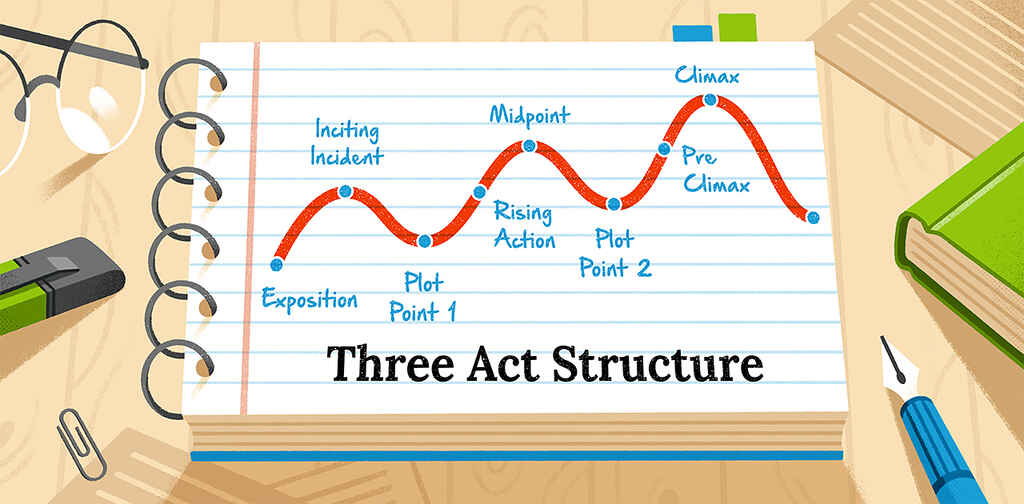
3. Three Act Structure
Following
the old adage that “every story has a beginning, middle, and end,” this
popular structure splits a story’s components into three distinct acts:
Setup, Confrontation, and Resolution. In many ways, the three-act
structure reworks The Hero’s Journey, with slightly less exciting
labels.
Structure
Act 1: Setup
Exposition. The status quo or ‘ordinary world’ is established.
Inciting Incident. An event that sets the story in motion.
Plot Point One. The protagonist decides to tackle the challenge head-on. She ‘crosses the threshold,’ and the story is now truly moving.
Act 2: Confrontation
Rising Action. The story's true stakes become clear;
our hero grows familiar with her ‘new world’ and has her first
encounters with some enemies and allies. (see Tests, Allies, Enemies)
Midpoint. An event that upends the protagonist’s mission. (Similar to the climax in Freytag’s pyramid)
Plot Point Two. In the wake of the disorienting midpoint, the protagonist is tested — and fails. Her ability to succeed is now in doubt.
Act 3: Resolution
Pre Climax. The night is darkest before dawn. The protagonist must pull herself together and choose between decisive action and failure.
Climax. She faces off against her antagonist one last time. Will she prevail?
Denouement. All loose ends are tied up. The reader discovers the consequences of the climax. A new status quo is established.
When we speak about a confrontation with an antagonist, this doesn’t
always mean a fight to the death. In some cases, the antagonist might be
a love rival, a business competitor, or merely an internal or environmental conflict that our protagonist has been struggling with the entire story.
If you’re interested in using this model to plot your own story, read our guide to the three-act structure, and be sure to sign up to our free course on the subject.
FREE COURSE
How to Plot a Novel in Three Acts
In 10 days, learn how to plot a novel that keeps readers hooked
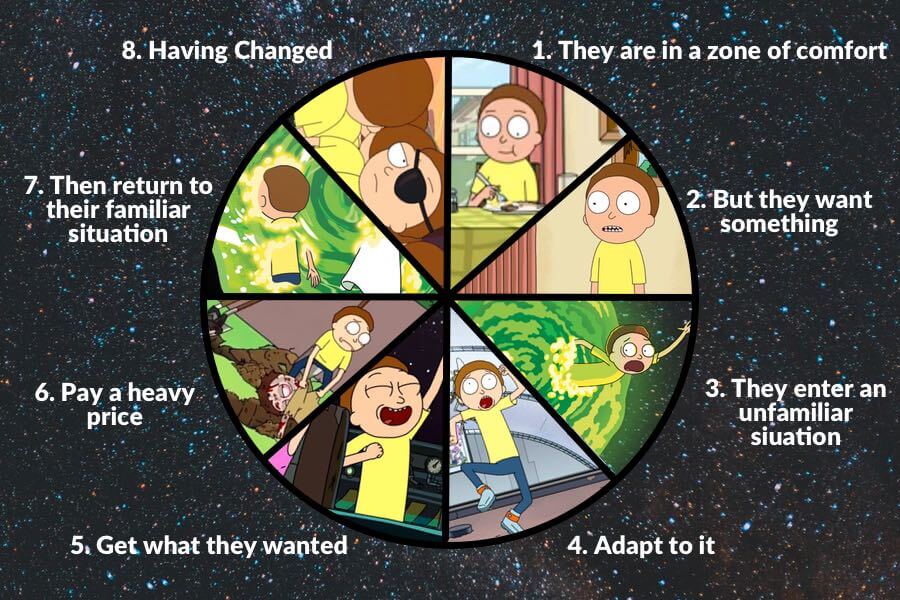
4. Dan Harmon's Story Circle
Another variation on Campbell’s monomyth structure, the Story Circle is an approach developed by Rick and Morty
co-creator Dan Harmon. Again, heavily inspired by the Hero's Journey,
the benefit of Harmon's approach is its focus on the protagonist's
character arc. Instead of referring to abstract concepts like 'story
midpoint' and 'denouement', each beat in the story circle forces the
writer to think about the character's wants and needs.
Structure
A character is in a zone of comfort... This is the establishment of the status quo.
But they want something... This 'want' could be something long-standing and brought to the fore by an inciting incident.
They enter an unfamiliar situation... The protagonist must do something new in their pursuit of the thing they want.
Adapt to it... Faced with some challenges, they struggle then begin to succeed.
Get what they wanted... Usually a false victory.
Pay a heavy price for it... They realize that what they 'wanted' wasn't what they 'needed'.
Then return to their familiar situation... armed with a new truth.
Having changed... For better or worse.
Created by a writer whose chosen medium is the 30-minute sitcom, this structure is worded in a waythat
sidesteps the need for a protagonist to undergo life-changing
transformations with each story. After all, for a comedy to continue for
six seasons (and a movie) its characters can't completely transform at
the end of each episode. They can, however, learn small truths about
themselves and the world around them — which, like all humans, they can
quickly forget about if next week's episode calls for it.
To learn more and see this structure applied to an episode of Rick and Morty, check out our full post on Dan Harmon's Story Circle.
Side note: for this kind of character-driven plot (and, indeed, for
all of these structures), you're going to want to know you're
protagonist inside and out. Why not check out some of our character
development exercises for help fleshing your characters out, like the
profile template below.
FREE RESOURCE
Reedsy’s Character Profile Template
A story is only as strong as its characters. Fill this out to develop yours.
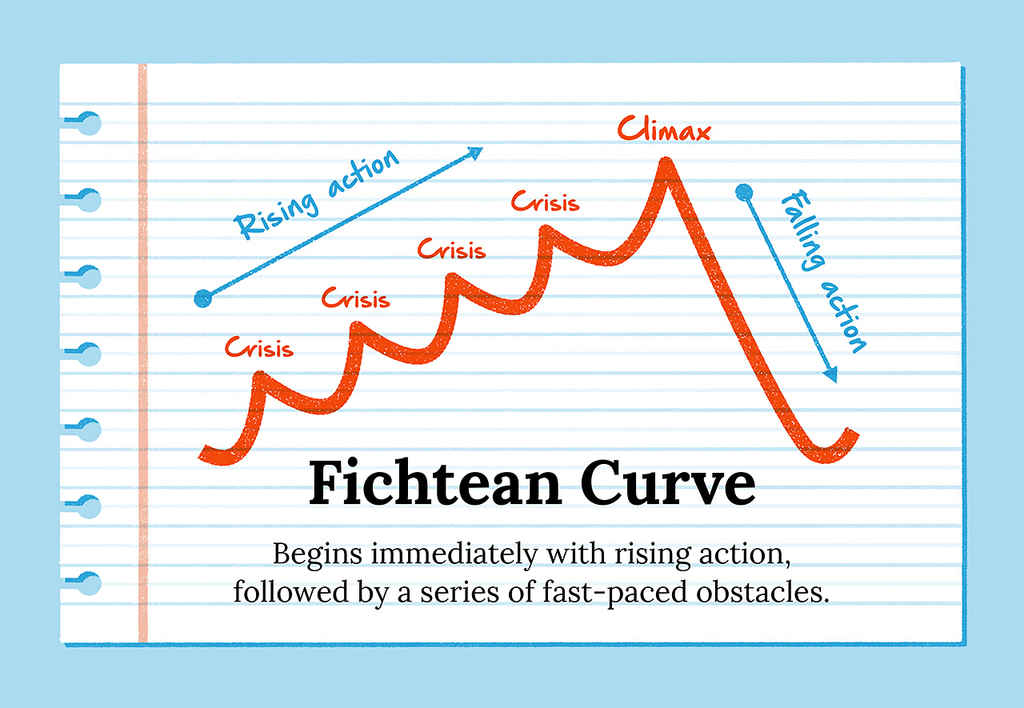
5. Fichtean Curve
Fleshed out in John Gardner’s The Art of Fiction, the
Fichtean Curve is a narrative structure that puts our main characters
through a series of many obstacles on their way to achieving their
overarching goals. Resembling Freytag’s Pyramid, it encourages authors
to write narratives packed with tension and mini-crises that keep readers eager to reach the climax.
Bypassing the “ordinary world” setup of many other structures, the
Fichtean Curve starts with the inciting incident and goes straight into
the rising action. Multiple crises occur, each of which contributes to
the readers’ overall understanding of the narrative — replacing the need
for the initial exposition.
Structure
To discuss this unusual structure, it’s perhaps best to see it in use. We’ll use Celeste Ng’s Everything I Never Told You as an example. Needless to say, spoilers ahead.
Rising Action
Inciting incident. The
novel begins with the line: “Lydia is dead. But they don’t know this
yet.” Within the first three paragraphs, Marilyn realizes that her
daughter Lydia is missing. Thus, readers are thrown straight into rising
action as Marilyn anxiously searches all the usual places Lydia might
be found.
First crisis. Lydia’s family is informed her body was
found in a nearby lake. From this first crisis's climax, the narrative
flashes back to provide exposition and details of the family’s history.
Second crisis. In flashbacks, we discover that, 11
years prior, Marilyn abandoned her family to resume her undergraduate
studies. In her absence, the family begins to fall apart. Marilyn learns
she is pregnant and is forced to return home. Having lost her
opportunity for further education, she places the pressure of academic
success on her children.
Third crisis. Back in the present, Lydia’s father,
James, is cheating on Marilyn. The police decide to close the
investigation, ruling Lydia’s death a suicide. This results in a massive
argument between her parents, and James leaves to stay with the “other
woman.”
Fourth crisis. Flashback to the day Lydia died. From
her perspective, we see that she’s misunderstood by her parents. She
mourns her brother’s impending departure for college, leaving her as the
sole focus of her parents’ pressure. Isolated, she tries to seduce a
friend — who rejects her advances and explains he’s in love with her
brother.
Climax
Lydia takes a boat into the lake in the middle of the night —
determined to overcome her fear of water and reclaim control of her
life. Lydia jumps off the boat, into the water, and out of this life. As
in a classical tragedy, this moment is both devastating and inevitable.
Falling Action
Some level of resolution is achieved, and readers get to at least
glimpse the “new norm” for the characters. Lydia’s family lean on one
another in their grief. While they may never be able to make their
amends with Lydia, they can learn from her death. Not all of the loose
ends are tied off, but readers infer the family is on the long road to
recovery.
Note: In the rising action stage, all of the crises should build
tension towards — and correspond with — the story’s major climax. Like
the three-act narrative structure, the Fichtean Curve’s climax typically
occurs two-thirds through the book.
While this structure lends itself well to flashback-heavy novels such as Everything I Never Told You, it is also incredibly common in theatre. In stage plays like The Cherry Orchard and A Doll’s House,
the action takes place in a fixed time and place, but backstory and
character development are revealed through moments of high drama that
occur before the audience’s eyes.
For a deeper look at this structure, head to our full post on the Fichtean Curve.
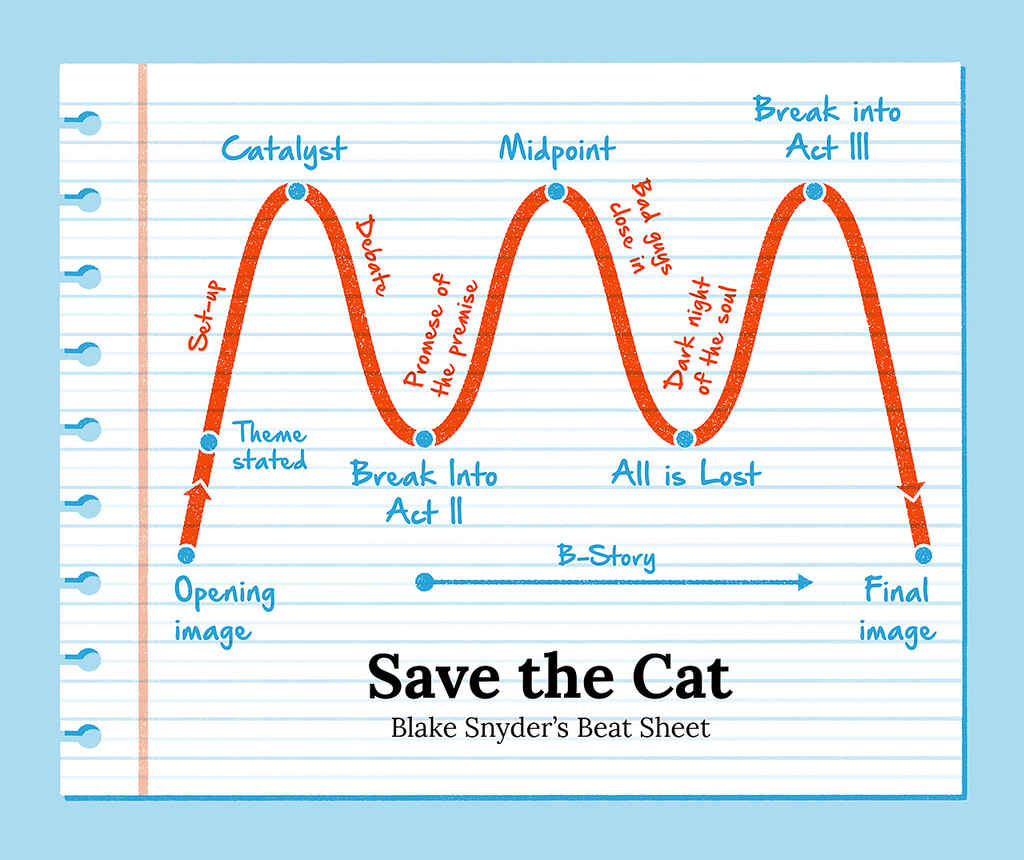
6. Save the Cat Beat Sheet
Another variation of the three-act structure, this framework created
by Hollywood screenwriter Blake Snyder, has been widely championed by
storytellers across many media forms.
Fun fact: Save the Cat is named for a moment in the set up
of a story (usually a film) where our hero does something to endear
himself to the audience.
While many structures are reluctant to prescribe exactly when in a story the various beats should take place, Snyder and Save the Cat
have no such qualms. The number in the square brackets below refers to
the page that the beat should take place — assuming you’re writing a
110-page screenplay.
Structure
Opening Image [1]. The first shot of the film. If you’re starting a novel, this would be an opening paragraph or scene that sucks readers into the world of your story.
Set-up [1-10]. Establishing the ‘ordinary world’ of your protagonist. What does he want? What is he missing out on?
Theme Stated [5]. During the setup, hint at what your story is really about — the truth that your protagonist will discover by the end.
Catalyst [12]. The inciting incident!
Debate [12-25]. The hero refuses the call to adventure. He tries to avoid the conflict before they are forced into action.
Break into Two [25]. The protagonist makes an active choice and the journey begins in earnest.
B Story [30]. A subplot kicks in. Often romantic in nature, the protagonist’s subplot should serve to highlight the theme.
The Promise of the Premise [30-55]. Often called the
‘fun and games’ stage, this is usually a highly entertaining section
where the writer delivers the goods. If you promised an exciting
detective story, we’d see the detective in action. If you promised a
goofy story of people falling in love, let’s go on some charmingly
awkward dates.
Midpoint [55]. A plot twist occurs that ups the stakes and makes the hero’s goal harder to achieve — or makes them focus on a new, more important goal.
Bad Guys Close In [55-75]. The tension ratchets up. The hero’s obstacles become greater, his plan falls apart, and he is on the back foot.
All is Lost [75]. The hero hits rock bottom. He loses
everything he’s gained so far, and things are looking bleak. The hero is
overpowered by the villain; a mentor dies; our lovebirds have an
argument and break up.
Dark Night of the Soul [75-85-ish]. Having just lost
everything, the hero shambles around the city in a minor-key musical
montage before discovering some “new information” that reveals exactly
what he needs to do if he wants to take another crack at success. (This
new information is often delivered through the B-Story)
Break into Three [85]. Armed with this new information, our protagonist decides to try once more!
Finale [85-110]. The hero confronts the antagonist or
whatever the source of the primary conflict is. The truth that eluded
him at the start of the story (established in step three and accentuated
by the B Story) is now clear, allowing him to resolve their story.
Final Image [110]. A final moment or scene that crystallizes how the character has changed. It’s a reflection, in some way, of the opening image.
Some writers may find this structure too prescriptive, but it’s
incredible to see how many mainstream stories seem to adhere to it —
either by design or coincidence. Over on the Save the Cat website, there
are countless examples of films and novels analyzed with Snyder’s 15 beats. You’ll be surprised how accurate some of the timings are for each of the beats.
For a deeper dive into this framework, and to watch this video where
Reedsy’s Shaelin plots out a Middle-Grade fantasy novel using Snyder’s
method — head to our full post on the Save the Cat Beat Sheet.
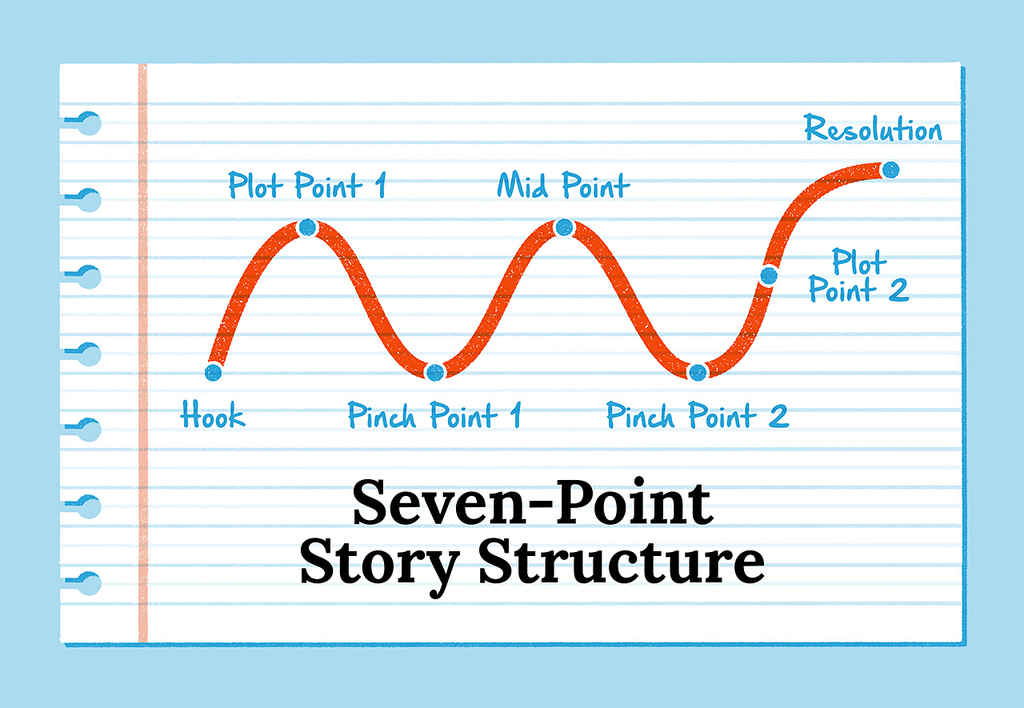
7. Seven-Point Story Structure
A slightly less detailed adaptation of The Hero’s Journey, the
Seven-Point Story Structure focuses specifically on the highs and lows
of a narrative arc.
According to author Dan Wells, who developed the Seven-Point Story Structure,
writers are encouraged to start at the end, with the resolution, and
work their way back to the starting point: the hook. With the ending in
mind, they can have their protagonist and plot begin in a state that
best contrasts the finale — since this structure is all about dramatic
changes from beginning to end.
Structure
The Hook. Draw readers in by explaining the
protagonist’s current situation. Their state of being at the beginning
of the novel should be in direct contrast to what it will be at the end
of the novel.
Plot Point 1. Whether it’s a person, an idea, an
inciting incident, or something else — there should be a "Call to
Adventure" of sorts that sets the narrative and character development in
motion.
Pinch Point 1. Things can’t be all sunshine and roses
for your protagonist. Something should go wrong here that applies
pressure to the main character, forcing them to step up and solve the
problem.
Midpoint. A “Turning Point” wherein the main character
changes from a passive force to an active force in the story. Whatever
the narrative’s main conflict is, the protagonist decides to start
meeting it head-on.
Pinch Point 2. The second pinch point involves another
blow to the protagonist — things go even more awry than they did during
the first pinch point. This might involve the passing of a mentor, the
failure of a plan, the reveal of a traitor, etc.
Plot Point 2. After the calamity of Pinch Point 2, the
protagonist learns that they’ve actually had the key to solving the
conflict the whole time.
Resolution. The story’s primary conflict is resolved —
and the character goes through the final bit of development necessary to
transform them from who they were at the start of the novel.
We've said it before, and we'll say it again: story structures aren't an exact
science, and you should feel welcome to stray from the path they
present. They're simply there to help you find your narrative's footing —
a blueprint for the world you're about to start building.

 Click to tweet!
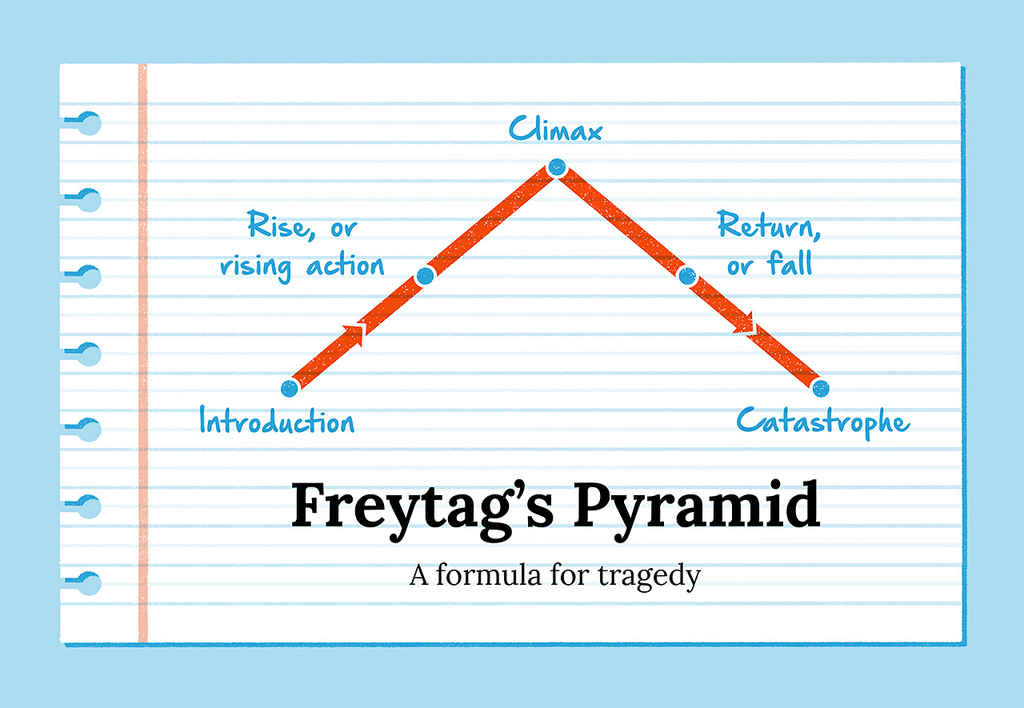 Named
after a 19th-century German novelist and playwright, Freytag’s Pyramid
is a five-point dramatic structure that’s based on the classical Greek
tragedies of Sophocles, Aeschylus, and Euripedes.
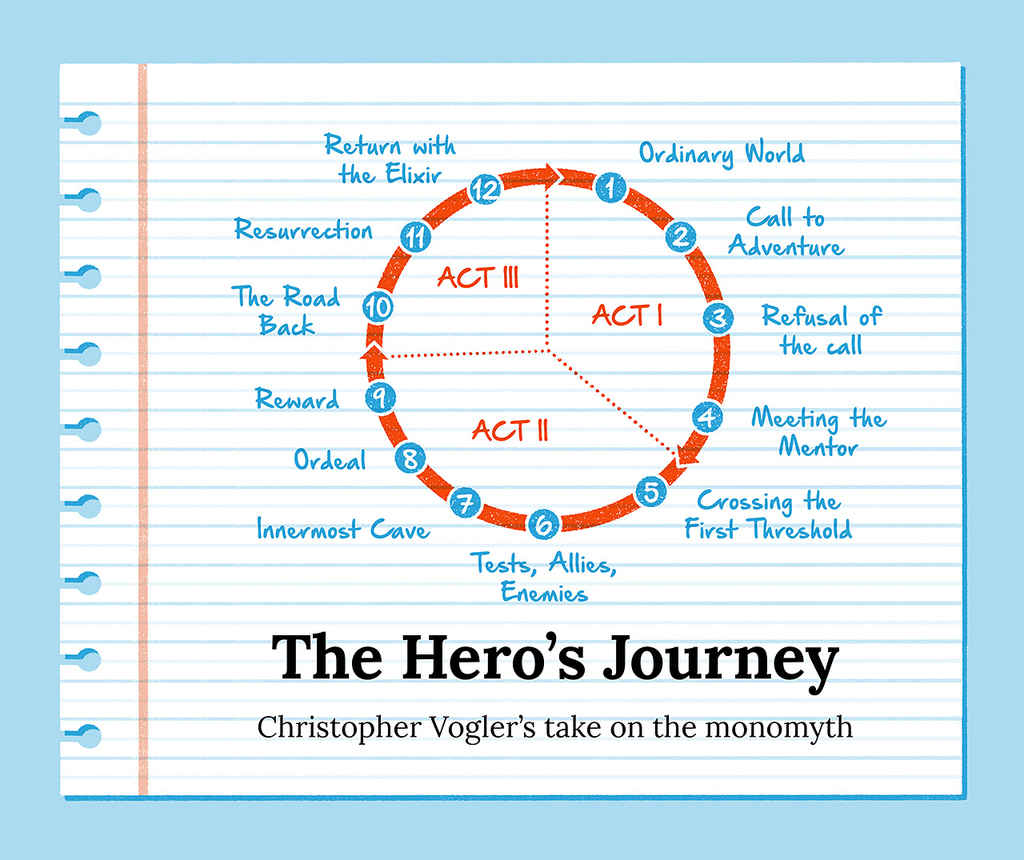 Inspired
by Joseph Campbell’s concept of the monomyth — a storytelling pattern
that recurs in mythology all over the world — The Hero’s Journey is
today’s best-known story structure. Some attribute its popularity to
George Lucas, whose Star Wars was heavily influenced by Campbell’s The Hero With a Thousand Faces.

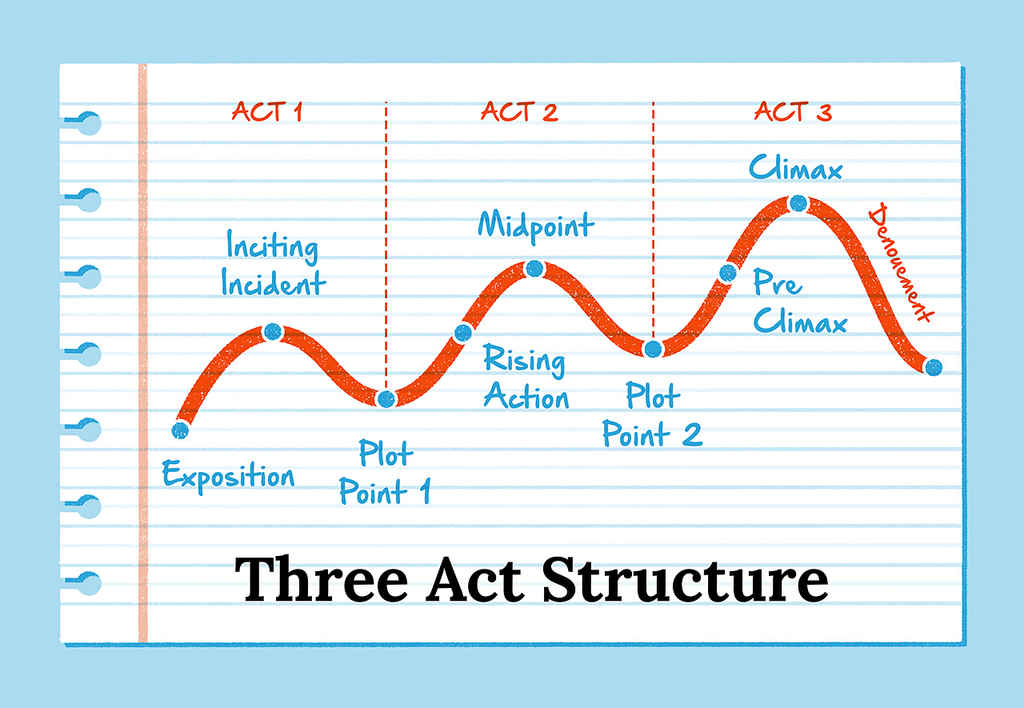 Following
the old adage that “every story has a beginning, middle, and end,” this
popular structure splits a story’s components into three distinct acts:
Setup, Confrontation, and Resolution. In many ways, the three-act
structure reworks The Hero’s Journey, with slightly less exciting
labels.